

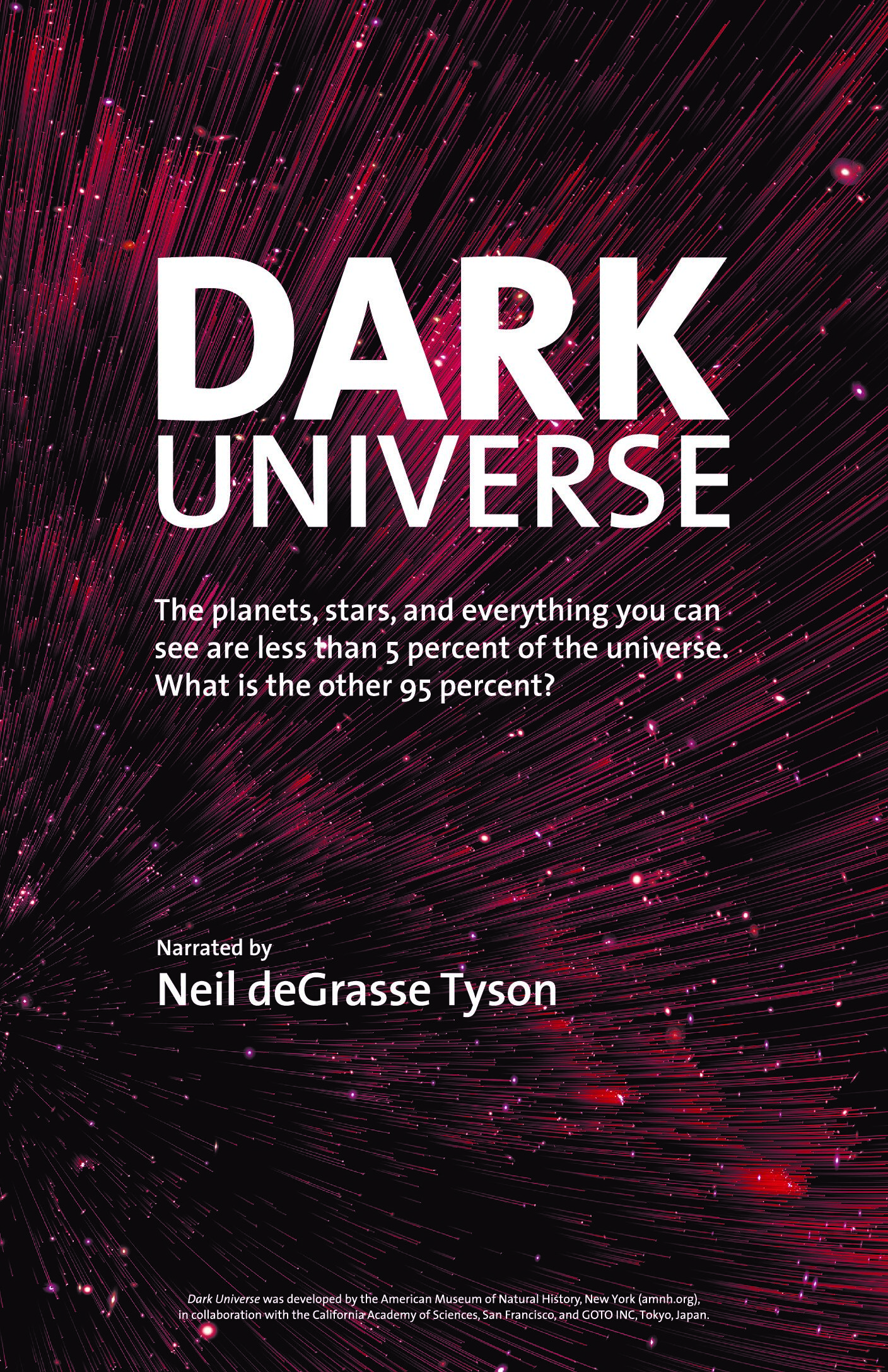
Dark Universe
2013 | Movie of American Museum of Natural History | English

25 mins
Licensing
Visually stunning show takes audiences through pivotal discoveries and captivating mysteries of the cosmos
Featuring exquisite renderings of cosmic phenomena, seminal scientific instruments, and spectacular scenes in deep space, the renowned space show Dark Universe celebrates the pivotal discoveries that have led us to greater knowledge of the structure and history of the universe and our place in it—and to new frontiers for exploration. Dark Universe whisks audiences out of the Milky Way galaxy, drops them alongside a parachute descending through Jupiter’s atmosphere, and brings them all the way to the afterglow of the Big Bang while revealing the breakthroughs that have led astronomers to confront two great cosmic mysteries: dark matter and dark energy.
Created by an award-winning team that includes American Museum of Natural History astrophysicists, educators, and science visualization experts, Dark Universe is an immersive theater experience based on authentic data from NASA and European Space Agency missions, ground-based telescopes, supercomputer simulations, and research conducted at institutions around the globe. It begins with a scene millions of light years away from Earth. After flying to our own Milky Way galaxy, viewers arrive at California’s Mount Wilson Observatory, where Edwin Hubble’s discovery that the universe is expanding first pointed to the Big Bang. That initial discovery, and ever more powerful instruments on the ground and in space, led to other breakthroughs that have given astronomers an increasingly detailed and precise picture of how our universe formed and evolved.
But these revelations have also uncovered intriguing new mysteries. What is the so-called dark energy accelerating cosmic expansion? What is the invisible dark matter holding together galaxies? What is dark energy, which accounts for about 70 percent of the universe’s total energy and mass? What lies beyond our cosmic horizon? Dark Universe explores this new age of cosmic discovery.
CREDITS
⎯⎯⎯⎯⎯⎯⎯⎯⎯⎯⎯⎯⎯⎯⎯⎯⎯⎯⎯⎯⎯⎯⎯
Dark Universe is curated by Dr. Mordecai-Mark Mac Low, a curator in the American Museum of Natural History’s Department of Astrophysics and Division of Physical Sciences who studies the formation and evolution of planets, stars, and galaxies.
The director of Dark Universe is Carter Emmart, the American Museum of Natural History’s director of astrovisualization and one of the original team members of the NASA-funded Digital Galaxy Project, now known as the Digital Universe, which helped redefine how planetarium theaters present science to the public through immersive data visualization.
Dark Universe is produced by Vivian Trakinski, who directs the American Museum of Natural History’s Science Bulletins media program. Dr. Rosamond Kinzler, senior director of science education and co-curator of the American Museum of Natural History’s David S. and Ruth L. Gottesman Hall of Planet Earth, is the executive producer.
Narrating the new Space Show is Dr. Neil deGrasse Tyson, astrophysicist, prolific science communicator, and the Frederick P. Rose Director of the Hayden Planetarium. Best-selling science writer Timothy Ferris wrote the script, and the score is by Robert Miller, a New York City composer.
Dark Universe was developed by the American Museum of Natural History, New York (www.amnh.org), in collaboration with the California Academy of Sciences, San Francisco, and GOTO Inc., Tokyo, Japan.
Dark matter visualizations developed by the Kavli Institute for Particle Astrophysics & Cosmology at Stanford University and SLAC National Accelerator Laboratory.
About the American Museum of Natural History (amnh.org)
The American Museum of Natural History, founded in 1869, is one of the world’s preeminent scientific, educational, and cultural institutions. The Museum encompasses more than 40 permanent exhibition halls, including the Allison and Roberto Mignone Halls of Gems and Minerals, which opened in 2021 – those in the Rose Center for Earth and Space and the Hayden Planetarium, as well as galleries for temporary exhibitions. The Museum’s scientists draw on a world-class research collection of more than 34 million artifacts and specimens, some of which are billions of years old, and on one of the largest natural history libraries in the world. Through its Richard Gilder Graduate School, the Museum grants the Ph.D. degree in Comparative Biology and the Master of Arts in Teaching (MAT) degree, the only such free-standing, degree-granting programs at any museum in the United States. The Museum’s website, digital videos, and apps for mobile devices bring its collections, exhibitions, and educational programs to millions more around the world. Visit amnh.org for more information.


